News
Put the power underground
Council looks at potential for underground electrical
The Boston City Council recently held a hearing to go through the pros and cons of putting electrical wires underground, as opposed to the telephone poles hanging wires throughout the city.
While Eversource representatives said much of the network is mixed and a majority of wires are currently underground, putting the entire network below stairs would be a challenge.
The biggest problem of overhead wires highlighted during the hearing was that of fire, as it was a response to a fire that took place in Charlestown over the summer due to a downed wire. Eversource Community Service Liaison Michael Fitzierald said the wired degraded due to extreme heat, which caused the initial failure.
The fire caused quite a scene, as the downed wire fell on a car and started a large fire. Fitzgerald said the response to the issue was delayed because of a fault of classification. He said they have a system that uses tiers, and this was placed as a fire police standby (FPS) level 3, the lowest priority, usually signaling the blockage of a street.
“This call should have come in as an FPS 2 and probably could have been escalated to an FPS 1 once the wires caught fire due to the proximity of the houses,” he said. “Our crew was late to arrive due to the misclassification of the emergency call, and due to traffic. If the call did come in as an FPS 2 or 1, we would have been able to remotely de-energize the area, which would have given Boston Fire more time to put that fire out.”
Fitzgerald said they had not determined the specific issue that caused the fire, aside from wire insulation degredation due to extreme heat. Eversource, Verizon, and National Grid representatives went through the proactive inspection routine(s) regarding the overhead wires, which boiled down to inspections about every three-to-five years depending on the type of service provided.
Putting electrical lines underground has some obvious advantages. There wouldn’t be these kinds of dangers to people, for instance; the likelihood of extreme heat affecting lines underground is remote.
However there are some disadvantages too. The biggest danger comes when lines are underground in earthquake-prone areas. This is why Tokyo in Japan has a myriad spider’s web of criss-crossing lines throughout the area. The biggest disadvantage discussed during the public hearing, however, was cost and convenience.
Eversource Distribution Engineering Director Pooja Shah said currently much of Boston’s grid is underground. She said the company itself looks at “resiliency and reliability” of existing service when determining whether it needs an upgrade or to be put underground.
“That’s determined by our engineering standards,” he said. “If a town or municipality decides it wants to underground its infrastructure, it’ possible, we can underground. I do understand the city or municipality bears the cost in that case.”

“But we’re talking about the ratepayers also bearing the cost, so now I’m confused,” said District 1 City Councilor and hearing sponsor Gabriela Coletta Zapata.
Shah said it’s about who is pushing for the undergrounding of services. If it’s the municipality, the city or town bears the capital costs. If it’s the utility, the ratepayers end up paying through increased rates. However, she did say that the costs to install service lines and new meters when a line is being undergrounded are also at least partially born by each individual homeowner.
She said for Eversource’s considerations when a customer – a municipality – wants to put wires underground, they suggest making sure it’s worth it, by making enough room for future growth, or make it part of a load-increasing project like transferring heating from gas to electric or the installation of electric car chargers.
“Because we’re digging the streets up and putting everything underground,” she said.
And it can be quite a process. District 9 City Councilor Liz Breadon chimed in that the Lake Street underground project – the street that connects Commonwealth Avenue and Washington Street – has been going on for almost six years (the same time she’s been in office). That project is, hopefully, looking to wrap up this summer.
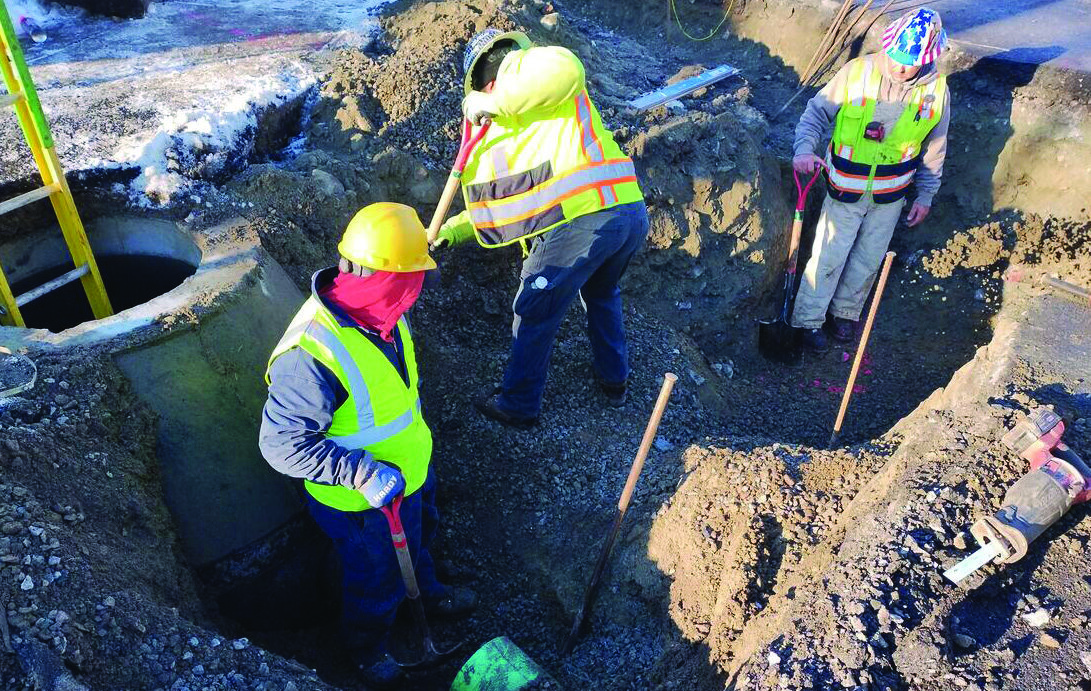
Boston Public Improvement Commission Engineer Todd Liming also pointed out examples from the undergrounding of the wires at American Legion that there can be severe impacts to residents, as each service line has to go through homeowners’ basements. He said the process can take a long time because all the other underground services – water, sewer, gas, etc. – have to be accounted for and protected from the work.
Transportation is another issue, as traffic has to be rerouted. And that’s not counting how much the utility would increase rates to pay for such infrastructure, as it is the utility’s prerogative to do so (though all “public” costs of construction would be reimbursed by the utility).
About the author
Jeff Sullivan Covers local news and community stories.
More in this section
E-5 District needs community engagement to help fight crime
Residents are E-5’s eyes and ears
October 22, 2026
Three housing applications pass easy at ERNA
Yet Ross Field disturbances still an issue
October 22, 2026
Comments